What Is a Baler?
A baler gathers hay, alfalfa stalks and straw in the field, compresses them and ties them into stackable packages. Types, twine systems and who they suit.
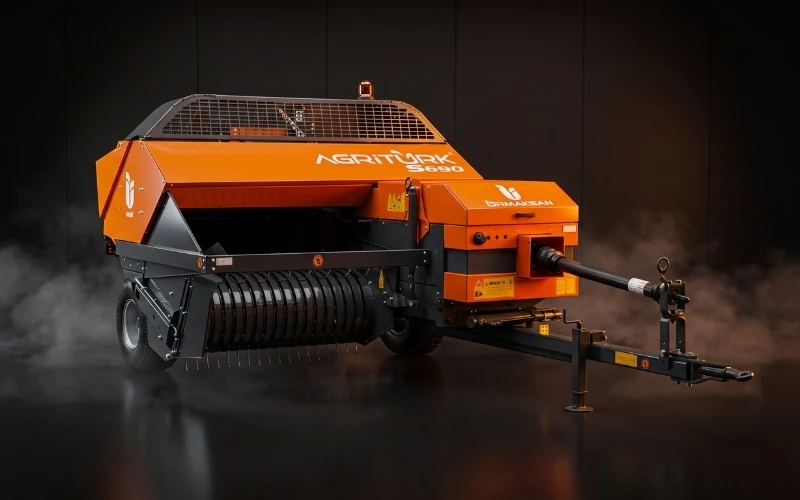
A baler is an agricultural machine that picks up hay, alfalfa, stalks, straw and similar forage from the field, compresses it and turns it into neat, transportable packages. If leftover material is left scattered it takes up space, gets wet, spoils and is hard to move. The baler turns that loose pile into standard-size bales tied with twine or wire. Storage, loading, selling and feeding then sit on a regular chain.
In everyday speech “bale” often means a rectangular pack. Round bales exist too; in hay and alfalfa practice in Turkey, tractor-drawn rectangular (square-section) balers are common. Ürmaksan’s AGRİTÜRK series belongs to that family: 2-twine or 3-twine models with different pickup and feeder widths, chosen for the farm’s land and tractor power.
What is a bale, and why pack it?
A bale is a compressed block of forage. Compression does two jobs. First it cuts volume: the same hay that fills a truck loose takes several times less space as bales. Second it standardises shape: stacking, pallets, racks and feed alleys can be planned. A loose straw heap is hard to handle with a fork or loader; a tied bale can be moved by hand, hook or loader.
Packing also reduces the surface exposed to air. A bale made at the right moisture is less affected by rain and dew, and mould risk falls. Compressing wet hay, though, can heat and spoil. The machine alone does not guarantee quality; cutting time, raking and moisture checks are part of the job.
Where the baler sits in the harvest chain
The baler is one of the last links. Hay or alfalfa is cut, dried in the field and raked into a windrow. The baler then takes that row with the pickup, compresses it and ties it. The tractor PTO drives the machine. The operator matches speed, windrow thickness and settings to the field.
If the chain breaks, bale quality drops. Over-wet hay causes knotter trouble, loose bales or over-tight, heating packs. Over-dry, brittle stalks dust and lose leaves. So “what is a baler?” is not only a steel box; it is a system that has to run at the right time in the right order.
Main types: rectangular and round
Round balers make cylindrical bales, often preferred in larger dairy operations and some straw logistics. Rectangular balers produce prism-shaped packs that stack easily. For barn mangers, truck beds and store racks, rectangular bales are practical. On small and medium farms 2-twine machines stand out; where denser, larger bales are wanted, 3-twine wide-pickup models lead.
Models such as the AGRİTÜRK S 690 Mini — 2-twine, skid, no feeder — suit narrower rows and more modest tractor power. In the S 190 family, wide pickup, feeder and fork hopper raise capacity. A “baler” is not one product; it is a family defined by working width and tying system.
Twine, knots and tying
Classic hay balers tie with special baler twine. Spools sit in holders on the machine; the knotter cuts and ties at each bale length. A 2-twine machine has two ties, a 3-twine machine three. More twine helps heavier, wider bales stay together. Twine quality matters as much as knot and tension; cheap, stretching twine means burst bales in the field.
Wire tying still appears on some heavy straw jobs. For hay and alfalfa, twine is common because mixing twine into feed is less risky than wire, and twine is easier to handle. Twine should still be agricultural grade and fit feed-hygiene rules.
Pickup, piston and skid
The pickup takes the windrow with a tined drum. A wide pickup cuts losses on scattered or thick rows. The feeder meters material into the chamber. The piston compresses it with rhythmic strokes. Skids or wheels keep the machine stable on the ground. Compact models without a feeder suit simpler work and lower power; on heavy, wet or thick rows a feeder line meters more evenly.
Each of these parts is the concrete answer to “what is a baler?”. The machine is not a box; it is a mechanism that repeats pickup–feed–compress–tie–eject. Maintenance follows the same order: tines, bearings, piston housing, knotter jaws and twine path need regular checks.
Who uses one?
Hay and alfalfa growers, straw sellers, and cattle and small-ruminant farms are the natural users. Farms that grow their own feed shrink storage space. Commercial hay and straw sellers can talk price and logistics on a standard bale size. For custom harvesters the machine is measured by how many bales it makes in a day.
The right machine must match PTO power, field size and windrow pattern. Too little power means blockages and uneven bales. An oversized machine wastes money and manoeuvring on small plots. That balance is what stops a baler being “the same box for everyone”.
In short, a baler is a tractor-powered harvest machine that compresses and ties forage into a stackable product. Once that is clear, the next question is natural: what exactly does it do in the field, and what does it earn the farmer?